The founder story
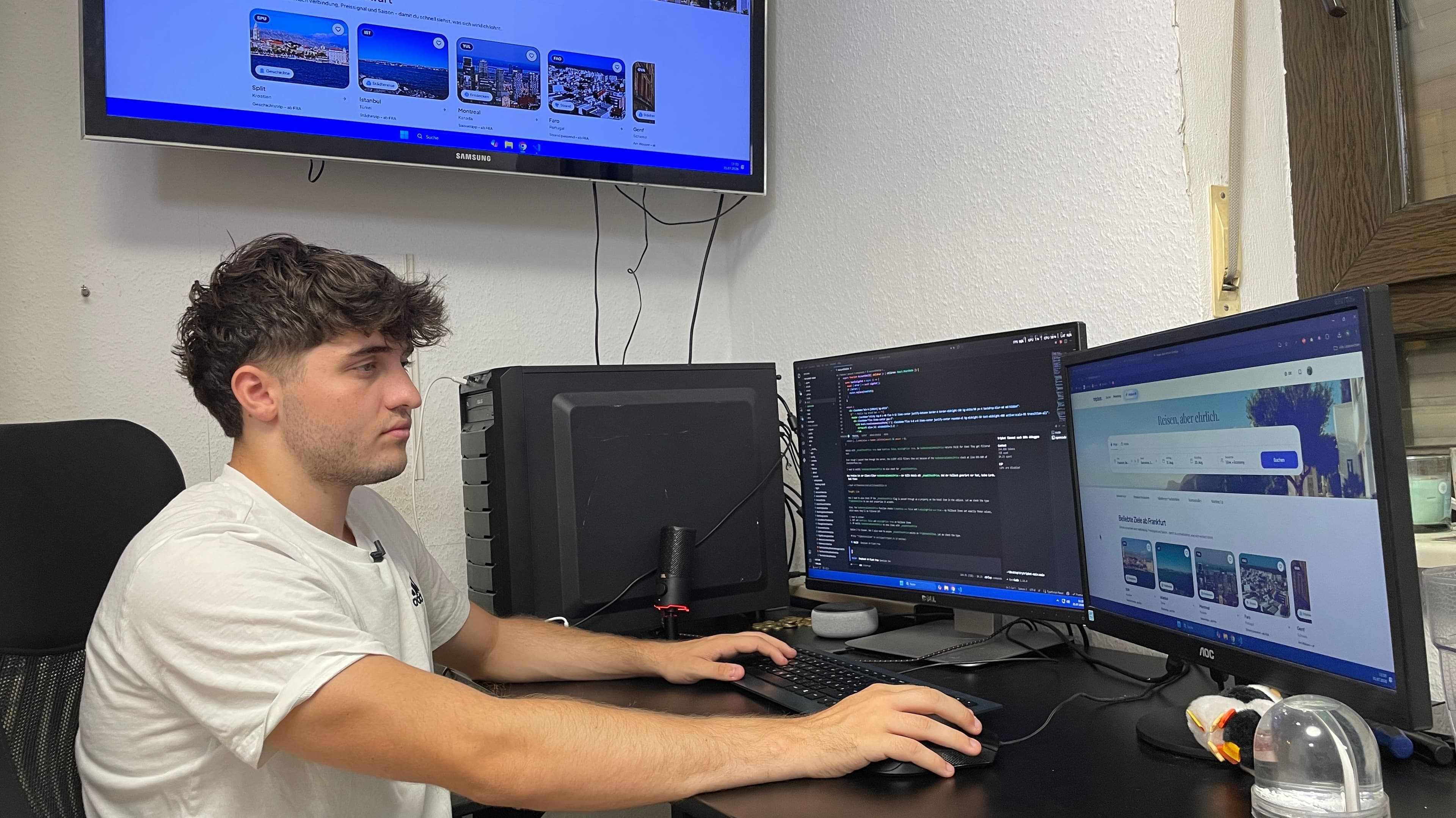
Hi, I'm Nico.
I'm building tripbot because I wanted to know where I could actually afford to go.
Not “how much does Rome cost” — the other way round: this is my budget, these are my free days, so where does that get me? No travel site answers that question. They all want to know the destination first. So I started building one that works backwards.
21 years old, from Adelsdorf in Franconia, Germany. Founder of tripbot.

What set this off
Twenty tabs and a spreadsheet that was out of date before I finished it.
I wanted to get away. A budget in my head, a few free days in the calendar, nothing else fixed. No particular destination — and that was the problem, not the solution.
Every travel site starts with the same field: where to? That was the question I was looking to have answered. I knew what I could spend. I knew how much time I had. I did not know which places fit inside that frame — and nobody told me.
So I did it by hand. Flights in one place, hotels in another, reviews in a third, the map in a fourth, and because I wanted to compare two departure airports and three possible weeks, every destination turned into its own fresh set of tabs. At some point there were twenty of them, and I was typing prices into a spreadsheet because there was no other way to see them side by side.
After two evenings the spreadsheet was out of date, because the flight prices had moved. I was tired, I had booked nothing, and I was no more certain than when I started. That was the moment — not anger at any company, just the plain realisation that I was spending hours on work a machine could do in seconds.
That was mid-2025. Roughly a year later the first version of tripbot was running.
You only want to find a good trip — and suddenly you have twenty tabs open.

How this came about
I actually wanted to be a pilot. I ended up writing code.
The plan was a different one: flying, not building. Travel was always the thing that made freedom tangible for me — hence the pilot's dream. The direction stayed; only the route there looks different now.
I have no computer science degree and no developer training. This year I finished my Fachabitur at the vocational grammar school in Erlangen. Everything that makes up tripbot I taught myself alongside it: through YouTube, through documentation, through a great many evenings where something did not work and I wanted to know why.
AI was my tool in that, and I say so openly, because otherwise it looks like I am hiding something. It made me faster — roughly by a factor of five. Not because it does the thinking for me, but because it shortens the time between “I don't understand this yet” and “I understand it”. A good tool does not turn a beginner into an expert. It turns a beginner who wants to know something into one who knows it, sooner.
What I do not mean by that: that code runs here which I have not read. What goes live, I checked and decided. If a booking goes wrong tomorrow, that is not a model's mistake. It is mine.
I didn't just want to talk about an idea. I wanted to see whether I could build it.
The rule the AI has to follow
The language model may explain. It may not invent anything.
At tripbot, classic travel search and AI search are two different paths that are connected to each other — but deliberately kept apart in the code. It is the most important decision in the whole product, and it is invisible from the outside, which is why I am writing it down here.
Prices and availability come from the interfaces of real suppliers. Always. The language model may understand your request, it may recognise what matters to you, it may sort results and explain why one suits you better than another. It may not calculate a flight price, claim availability, or invent a hotel that does not exist.
I am not promising infallibility. A hundred per cent guarantee that a generative system never makes a mistake would be dishonest — and anyone who gives you one has either not understood how the technology works or is hoping that you have not. What I do instead: keep the places where a mistake can arise at all as small as possible. Everything that counts — price, date, availability, conditions — comes from the data, not from the model.
That is also why tripbot does not look like a chat window with a search box next to it. The AI sits as a layer on top of a real booking platform. It is not the trick the product is sold with.
Where tripbot stands today
On price and availability I am not competitive yet. I would rather say that myself.
tripbot searches real flights and real hotels at connected suppliers and can book them for real. Payment runs through Stripe. This is not a comparison site that sends you somewhere else at the end.
What tripbot cannot do today: beat the large portals. My inventory is smaller. My terms are those of a supplier who is just starting out — and terms depend on volume I do not have yet. There are searches where the better price is simply somewhere else.
I could leave that out and hope nobody does the maths. Only then every other sentence on this page would be worth nothing either. Anyone who compares and books cheaper elsewhere has decided correctly — and afterwards I know more precisely what I have to work on.
What tripbot already does better than any site I sat on back then: answer the question backwards. Say what you want to spend and how much time you have, and a few destinations come back that you can actually book — instead of an empty form that wants to know your destination first.

How I make money
Commission and an optional subscription. Nothing else.
I think this belongs on a founder's page, because it decides whether a product works for you or against you. If a platform earns money from you booking the wrong thing, you will notice sooner or later.
tripbot earns a commission when you book — paid by the supplier, not added on top for you. Beyond that there is a voluntary Pro subscription for people who want to get more out of the AI. The core product stays free and usable without an account.
What I deliberately do not do: buy the first ten thousand active users through expensive ads. And not raise a large funding round just to pay for marketing channels I do not yet know work. The next twelve months are not about maximum reach, they are about a foundation that holds.
What came of it
Bavarian public broadcasting filmed a piece, because I simply asked.
At some point I wrote to the newsroom and told them what I was building. No contact, no agency, no PR firm — one email. Bayerischer Rundfunk filmed a piece about tripbot; it ran in Frankenschau and afterwards in the ARD media library, plus an article on BR24.
It had started earlier, in March, when Franken Fernsehen ran a piece — I was still at school then. Later came a portrait in the Nürnberger Nachrichten, and two founder interviews in which I had to explain, for the first time in one go, what it is I am actually doing here.
None of that makes my product better, and I am not pretending it is a seal of approval. But it is the opposite of what usually sits on pages like this: not a carpet of “as seen in” logos, but a few pieces you can watch and judge for yourself.

Nico Neser
21 years old, from Adelsdorf in Franconia, Germany. Founder of tripbot.
What I don't do
No artificial pressure. Anywhere.
These are not values for a wall, they are things you can hold me to. If you find a place where tripbot breaks one of them, write to me — that is a bug, not a feature.
No invented scarcity
“Only 1 room left”, “12 people are looking right now” — sentences like that appear only if they are true and come from the supplier's data. Otherwise they are not there. A countdown that starts over on every reload is a lie with an animation.
No hidden fees
The price you see first is the price at the end. Whatever the supplier adds is shown alongside it before you decide — not in the last step, once you have entered your details and no longer feel like starting over.
No fantasy prices
No struck-through price that never existed. No discount that applies every day and is therefore not one. If something is cheaper than usual, you can see why.
No numbers I cannot back up
There is no user count on this page, no revenue figure and no rating I awarded myself. When the time comes, I will write it down — with a date. Not before.
Where this is going
Every booking makes the next one cheaper.
The coming year has three jobs, and none of them is a number on a slide.
First: connect more suppliers. More hotels, more airlines, more routes. Larger inventory means better terms, better terms mean prices that can stand next to the large portals. That is exactly why every single booking counts — it is the argument for the next contract. That is not an appeal, it is simply how this business works.
Second: make the AI better, on real searches rather than invented ones. The advantage does not come from tripbot talking more people into more trips. It comes from every new plan being able to build on what was already understood before.
Third: find people who care about the thing and want to think along — now, while it is still possible to shape what this becomes, and not once everything has been decided. There is an open roadmap, and what lands on it is decided in part by the people who use tripbot.
And further out, without any promises: a multilingual European travel platform with hotels connected directly. That is the direction. Whether the timeline holds is decided by the work in between, not by my announcement.

Over to you
Try the question I failed at back then.
Say what you want to spend and how much time you have. No account needed, no credit card, no countdown.
More about tripbot
Explore tripbot.
Common questions
What people ask me
Can I really book through tripbot?
Yes. Flights and hotels are booked for real at connected suppliers, and payment runs through Stripe. tripbot is not a comparison site that forwards you to another page at the end.
Is tripbot always the cheapest?
No, and I do not claim to be. My inventory is smaller than that of the large portals, and my terms are those of a supplier who is starting out. Compare freely — if you book cheaper elsewhere, that was the right call.
How much of this is AI?
Search, prices and booking are ordinary technology using real supplier data. The AI helps with the decision: understanding what you want, comparing, placing it in context, explaining. It does not invent prices or availability — that is kept technically separate.
What does tripbot cost me?
Using it is free. tripbot earns a commission from the supplier when you book. There is also a voluntary Pro subscription for more AI features — you do not need it in order to search and book.
Is there a company behind tripbot, or a person?
At its core a person — me, as a solo founder. A company is being built out of it; whoever joins in today helps shape what it looks like.
How can I help?
Use it and tell me what does not work. Honest criticism from real searches is worth more right now than any ad I could buy.